Scottish Clan Castles: History and How to Visit
Scottish Clan Castles: History and How to Visit
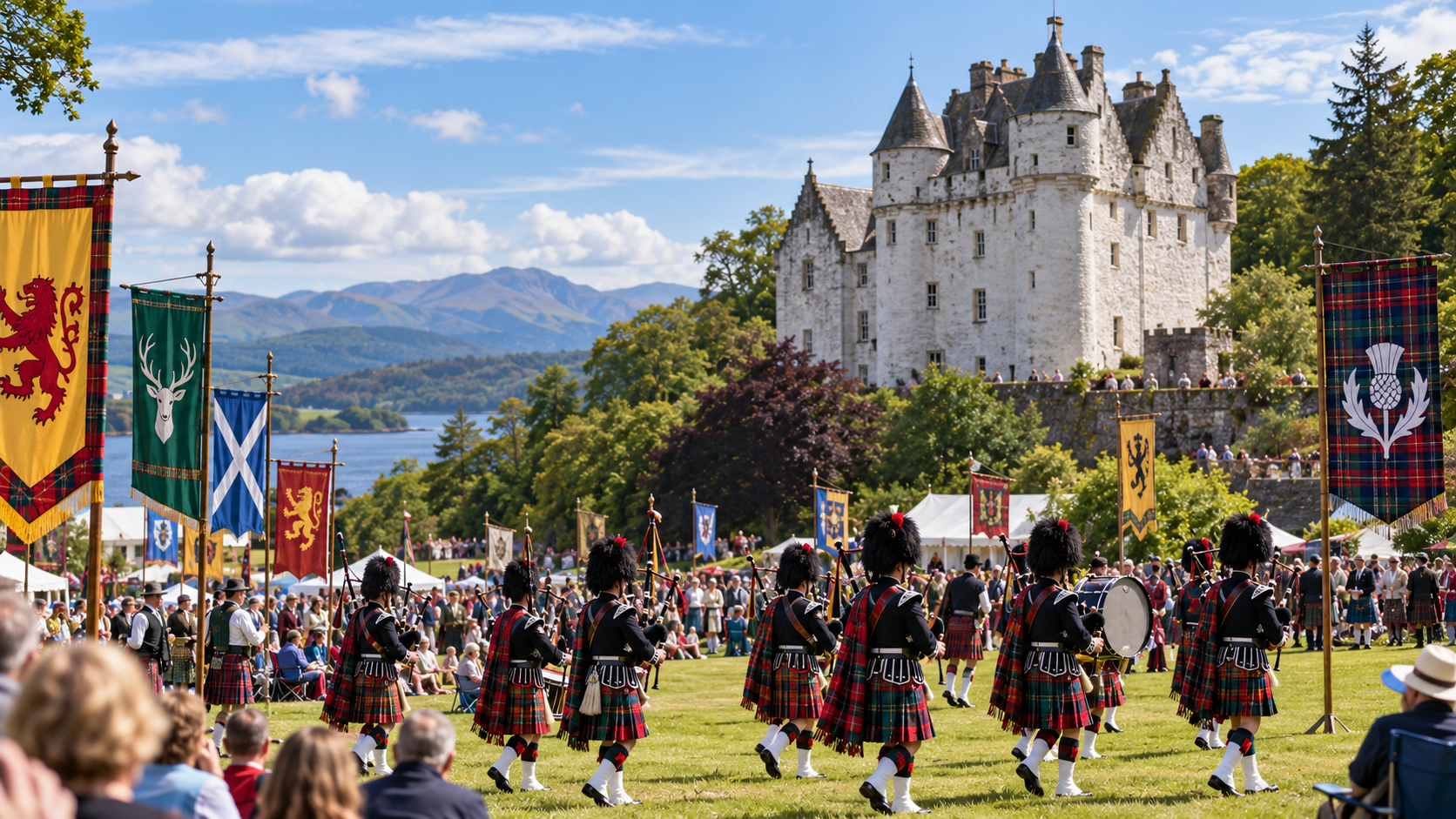
There’s something different about standing inside a castle where the same family has hung its portraits, fought its feuds and buried its secrets for 700 years. Scottish clan castles aren’t museums that happened to be castles. Many are still family homes, still flying the chief’s banner, still hosting clan gatherings that draw descendants from Canada, Australia and the US every summer.
In this guide, I’ll walk you through what a clan castle actually is, the history that shaped them, and six of the best Scottish clan castles you can visit, with practical tips on opening seasons, getting there and where to pitch your tent nearby.
What Is a Scottish Clan Castle?
A clan castle is the ancestral seat of a Scottish clan – the stronghold where its chief lived, held court and defended the clan’s lands. The word clann is Gaelic for “children”, and a clan was essentially an extended family united under one chief, plus the people who lived on and worked his land.
Some clan castles are still owned and lived in by the chief’s family (Dunvegan, Duart, Inveraray, Blair). Others are run by charitable trusts set up by clan members (Eilean Donan, Castle Menzies). And many more are romantic ruins in the care of Historic Environment Scotland or simply standing in a field.
A Short History of Scotland’s Clan Castles
Clan castles grew out of centuries of local power struggles, and their story tracks Scotland’s own.
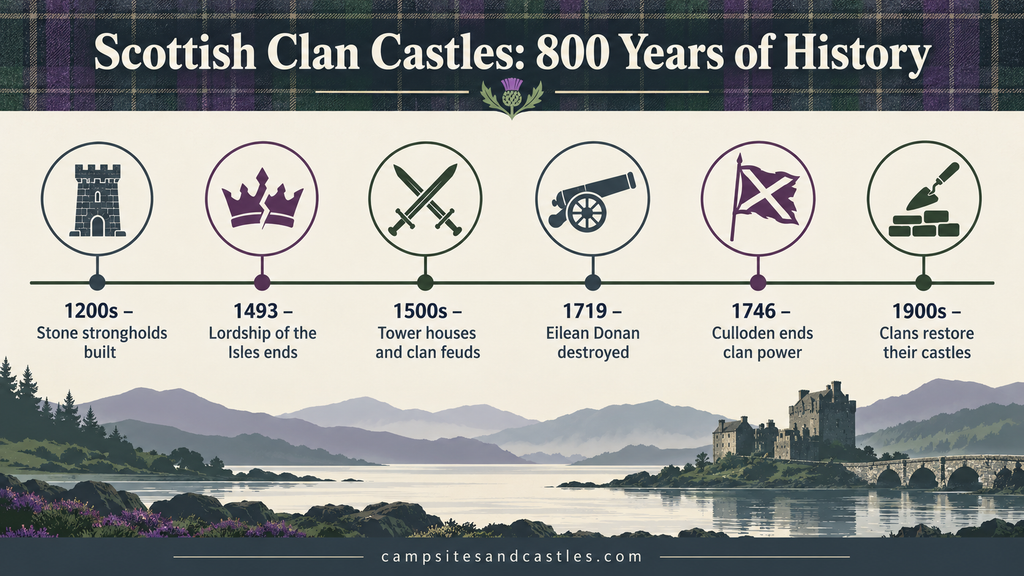
- 1200s–1300s: Stone strongholds. As clans consolidated their territory, chiefs built curtain-wall castles on headlands, islands and crags – places that were easy to defend and easy to reach by sea. Duart and Dunvegan both date from this era.
- 1400s–1500s: Tower houses and feuds. After the Crown broke the power of the Lordship of the Isles in 1493, rival clans scrambled for land. Tall stone tower houses, often built on L- or Z-shaped plans, became the standard clan seat.
- 1600s: The Crown pushes back. Laws such as the Statutes of Iona (1609) tried to rein in Highland chiefs, and the civil wars of the 1640s saw castles besieged and burned.
- 1689–1746: The Jacobite risings. Clans split between supporting the exiled Stuart kings and the government. Castles changed hands, were garrisoned, and in Eilean Donan’s case were blown apart.
- After Culloden (1746). The government crushed clan power: the Heritable Jurisdictions Act of 1747 stripped chiefs of their legal authority, and many castles were abandoned or left to rot.
- 1800s–2000s: Romantic revival. Victorian tartan-mania (helped along by Sir Walter Scott and Queen Victoria) made clan heritage fashionable again. In the 20th century, chiefs and clan societies bought back and restored ruined seats – which is why you can visit so many of them today.
6 Scottish Clan Castles You Can Visit
I’ve picked six clan castles that are open to visitors, still tied to their clans, and spread across the Highlands and islands so you can build them into a camping road trip.
1. Dunvegan Castle, Isle of Skye – Clan MacLeod
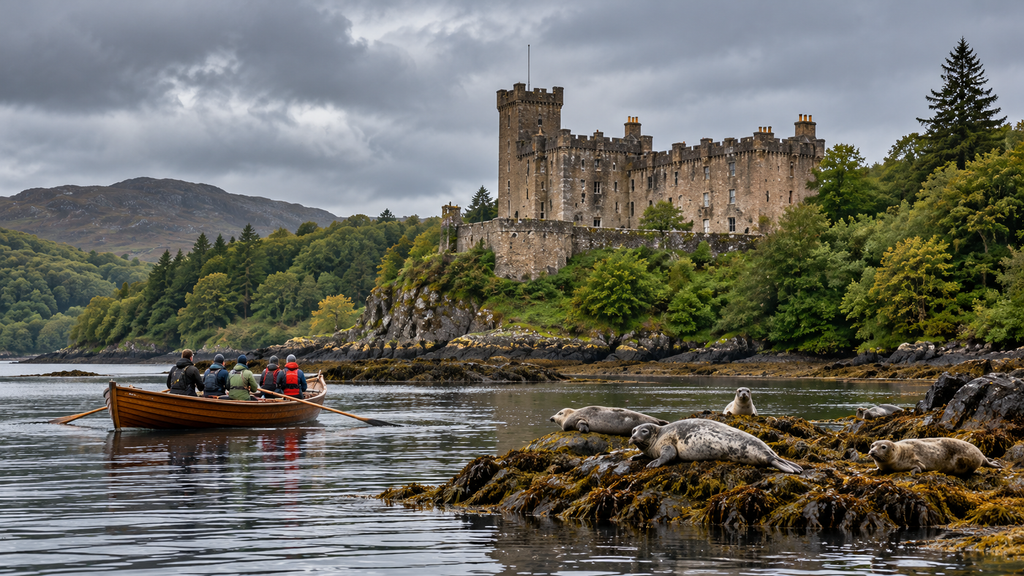
Dunvegan has been the seat of the MacLeod chiefs for around 800 years, and it’s often described as the oldest continuously inhabited castle in Scotland. It sits on a rock above Loch Dunvegan on Skye’s north-west coast.
History highlights: The castle’s most famous treasure is the Fairy Flag, a faded silk banner that legend says will save the clan in battle when waved. You’ll also see the Dunvegan Cup, a medieval wooden drinking vessel, and Rory Mor’s Horn, which each new chief must drain of claret in one go. Allow time for the five acres of gardens and a boat trip out to the loch’s seal colony.
How to visit:
- Season: typically 1 April – 15 October, daily 10am–5.30pm (last entry 5pm)
- Getting there: one mile from Dunvegan village, 23 miles west of Portree; free parking in season
- Time needed: 2–3 hours including gardens
- Clan events: the Clan MacLeod Parliament gathers at Dunvegan every four years (most recently August 2026)
Camp nearby: Kinloch Campsite sits on the loch shore just outside Dunvegan village, a few minutes’ drive from the castle.
2. Eilean Donan Castle, Dornie – Clans MacKenzie and MacRae
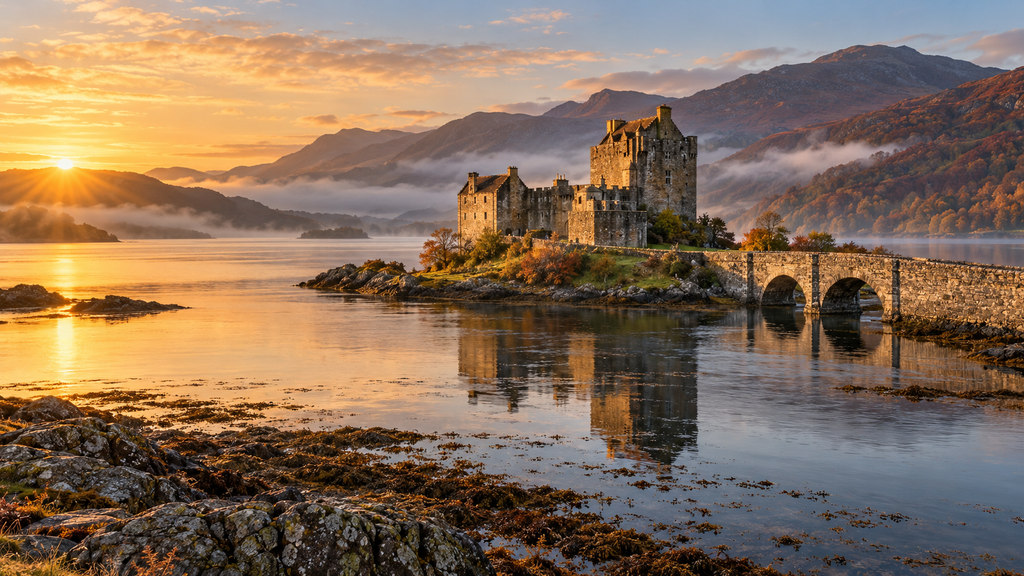
Eilean Donan is probably the most photographed castle in Scotland, sitting on a tiny tidal island where three sea lochs meet, linked to the mainland by a stone footbridge.
History highlights: It was built in the 13th century and became a MacKenzie stronghold, with the MacRaes serving as hereditary constables (keepers) from the early 1500s. In 1719 a small Jacobite garrison, including Spanish soldiers, held it; government warships bombarded it and the remains were blown up with the castle’s own gunpowder. It lay in ruins for almost 200 years until Lt-Col John MacRae-Gilstrap rebuilt it between 1912 and 1932. A charitable trust with family links to the MacRaes now runs it.
How to visit:
- Season: usually open from early February to just before Christmas; shorter 10am–4pm hours in winter and longer days in summer. It occasionally closes for weddings, so check before travelling
- Getting there: on the A87 at Dornie, about 8 miles from Kyle of Lochalsh and the Skye Bridge
- Photo tip: for the classic elevated view, drive up the Carr Brae road above Dornie
- Time needed: 1–2 hours
Camp nearby: the Camping and Caravanning Club site at Morvich, at the head of Loch Duich, is about 15 minutes away and makes a brilliant base for Kintail hill walks too.
3. Duart Castle, Isle of Mull – Clan Maclean
Duart stands on a cliff above the Sound of Mull, and it looks exactly like the castle a Highland chief ought to live in.
History highlights: The Macleans came by Duart in the 14th century when Lachlan Lubanach Maclean married Mary, daughter of the Lord of the Isles, and received the castle as her dowry. The clan lost it to the Campbells, Dukes of Argyll, in the late 1600s, and the government used it as a garrison until 1751 before abandoning it. In 1911 the 26th chief, Sir Fitzroy Maclean, bought back the ruin and restored it. The current chief, Sir Lachlan Maclean, still lives there.
How to visit:
- Season: typically April to mid-October
- Getting there: a short drive from the Craignure ferry terminal (CalMac from Oban, about 45 minutes)
- Good to know: major conservation works on the exterior mean scaffolding may be up, but the interior – dungeons, Great Hall, Sea Room and battlements – is open
- Time needed: 1.5–2 hours, plus the tearoom
Camp nearby: Shieling Holidays at Craignure is a short walk from the ferry and has tent pitches and “shielings” (cottage tents) looking across the Sound of Mull to Duart.
4. Inveraray Castle, Argyll – Clan Campbell
Inveraray is the odd one out: not a medieval fortress but an 18th-century Gothic Revival mansion with four corner turrets, built for the Dukes of Argyll, chiefs of the most powerful clan in the west.
History highlights: The 3rd Duke started the current castle in the 1740s and even had the old town of Inveraray demolished and rebuilt further along Loch Fyne to improve his view. The Armoury Hall’s ceiling is said to be the highest in Scotland at 21 metres, and the collection includes a sporran and dirk handle that belonged to Rob Roy MacGregor – a Campbell enemy. Downton Abbey fans will recognise it as “Duneagle Castle”.
How to visit:
- Season: in 2026 the castle opened 26 March – 26 October, Thursday to Monday only (closed Tuesdays and Wednesdays), 10am–5pm in summer and 10am–4pm in October
- Getting there: on the A83, about 60 miles from Glasgow; Scottish Citylink buses run from Glasgow
- Time needed: 2 hours, plus time in Inveraray town and the old jail
Camp nearby: Argyll Caravan Park sits on the shore of Loch Fyne just south of Inveraray and takes tents.
5. Blair Castle, Perthshire – Clan Murray
Blair Castle’s white walls are hard to miss from the A9. It’s the seat of the Dukes of Atholl, chiefs of Clan Murray, and home to Europe’s only legal private army, the Atholl Highlanders.
History highlights: Blair has hosted Mary Queen of Scots, Bonnie Prince Charlie and Queen Victoria. In 1746 it became the last castle in Britain to be besieged, when the Jacobite general Lord George Murray laid siege to his own family home while government troops held it. Over 30 rooms are open, including a ballroom hung with 175 pairs of antlers.
How to visit:
- Season: usually reopens 1 April and runs until late October
- Getting there: off the A9 at Blair Atholl; the railway station is a short walk from the gates, so it’s easy without a car
- Clan events: the Atholl Highlanders’ parade and the Atholl Gathering Highland Games take place on the castle grounds in late May
- Time needed: half a day, including the nine-acre Hercules Garden
Camp nearby: Blair Castle Caravan Park is on the estate itself – you can walk to the castle from your pitch.
6. Castle Menzies, near Aberfeldy – Clan Menzies
Castle Menzies is the best example of what a clan can do for its own heritage. It’s a 16th-century Z-plan tower house (a carved panel above the door is dated 1571), and it was the seat of the Menzies chiefs for over 500 years.
History highlights: In February 1746 Bonnie Prince Charlie stayed two nights on his way north to Culloden, and the Duke of Cumberland, the government commander, stayed just days later. After the last baronet died in 1910 the castle was sold and fell into ruin. In 1957 the newly re-formed Menzies Clan Society bought it for under £300 and its members spent decades restoring it by hand. It’s less furnished than other castles, which makes it feel more authentic, and it also houses the Clan Gregor Society’s museum.
How to visit:
- Season: spring to autumn; opening days are limited, so check the castle website before you go
- Getting there: at Weem, about 5 minutes’ drive or a 30-minute walk from Aberfeldy
- Clan events: the Menzies Clan Gathering takes place every August
- Time needed: 1–1.5 hours, plus the walled garden and the Old Kirk of Weem
Camp nearby: there are several riverside campsites around Aberfeldy and Kenmore on the River Tay and Loch Tay.
Bonus: Ruined Clan Castles Worth a Detour
If you prefer moody ruins to guidebooks and gift shops, add these to your route:
- Kilchurn Castle, Loch Awe (Campbells of Glenorchy): a free-to-visit ruin managed by Historic Environment Scotland, half an hour from Inveraray. Interior access is usually summer only.
- Castle Tioram, Loch Moidart (Clanranald): a tidal island castle you can walk out to at low tide. The building itself is closed for safety, but the setting is unforgettable.
- Dunnottar Castle, Stonehaven (Keiths, Earls Marischal): a vast clifftop ruin where the Scottish Crown Jewels were hidden from Cromwell’s army.
How to Plan a Clan Castle Trip
Check the season first. Most privately owned clan castles close from late October until spring. Plan for April to September for the best choice, and use winter for exterior photos and ruins.
Find your clan. If you have Scottish ancestry, look up your surname on the Standing Council of Scottish Chiefs website to find your clan and its seat. Many clans have “septs” – associated surnames – so a name like Beaton or Bethune might link you to the MacLeods.
Time your visit for a gathering. Clan gatherings and Highland Games are the best way to see a clan castle come alive with pipes, tartans and visiting clansfolk. Clan societies list dates online, usually a year ahead.
Book island ferries early. For Duart (Mull) and Dunvegan (Skye, via the bridge or the Mallaig–Armadale ferry), summer CalMac sailings with a car or campervan sell out weeks in advance.
Combine castles into a route. A loop of Inveraray → Duart → Eilean Donan → Dunvegan → Blair → Menzies takes in all six in a week to ten days.
Camping Near Scottish Clan Castles
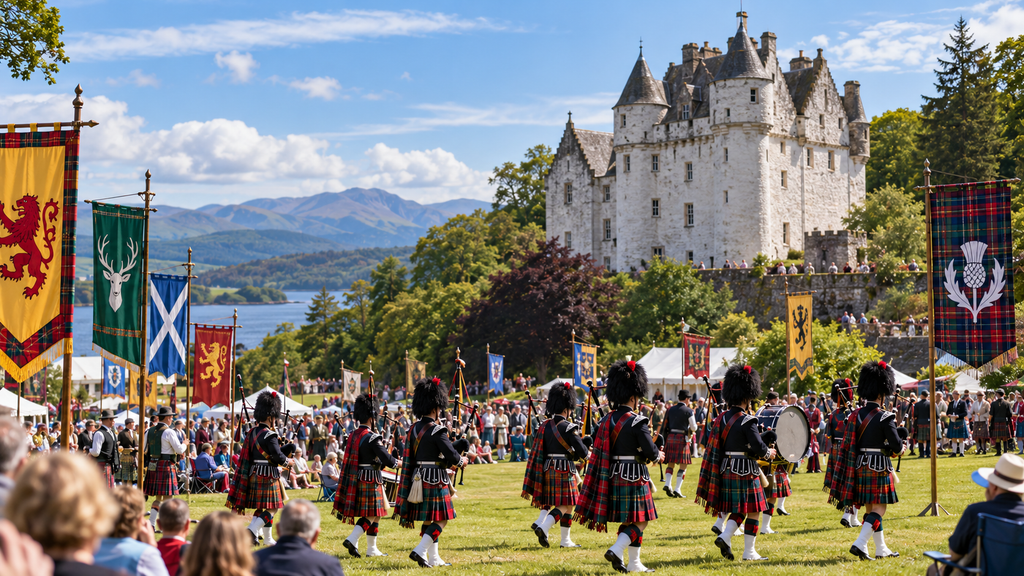
Camping is easily the best way to see clan castles: many sit in remote spots where hotels are pricey or scarce, and waking up on a loch shore with a castle across the water is hard to beat.
- Book ahead in July and August, especially on Skye.
- Wild camping is legal in most of Scotland under the Scottish Outdoor Access Code, but not on castle grounds or estates without permission, and seasonal camping restrictions apply in parts of Loch Lomond & The Trossachs.
- Pack for midges from June to September, especially on the west coast.
Wild Camping in the UK: The Complete Legal Guide, Best Spots & Safety Tips
Frequently Asked Questions
What is the oldest clan castle in Scotland? Dunvegan Castle on Skye is widely described as the oldest continuously inhabited castle in Scotland, home to the MacLeod chiefs for around 800 years.
Can you visit Scottish clan castles if you’re not a member of the clan? Yes. Clan castles that are open to the public welcome everyone, whatever your surname.
Do clan chiefs still live in their castles? Some do. The chiefs of Clan MacLeod, Clan Maclean, Clan Campbell and Clan Murray still live in or own their ancestral seats.
When are Scottish clan castles open? Most open from around April to October. Eilean Donan is one of the few open almost year-round, closing only from late December to the end of January.
Can I camp near Scottish clan castles? Yes. There are campsites within a few miles of all six castles in this guide, and Blair Castle has a caravan and camping park on the estate.
The Best Castles in Scotland: A Region-by-Region Guide
Final Thoughts
Scottish clan castles are some of the most rewarding heritage sites in the UK, because the history isn’t over. Families still live in them, clans still gather at them, and every restoration is a story of people refusing to let their heritage fall down. Pack the tent, pick a route, and go and meet the clans.
Opening times change every year – always check the castle’s official website before you travel.