The History of the English Castle: A Beginner’s Guide
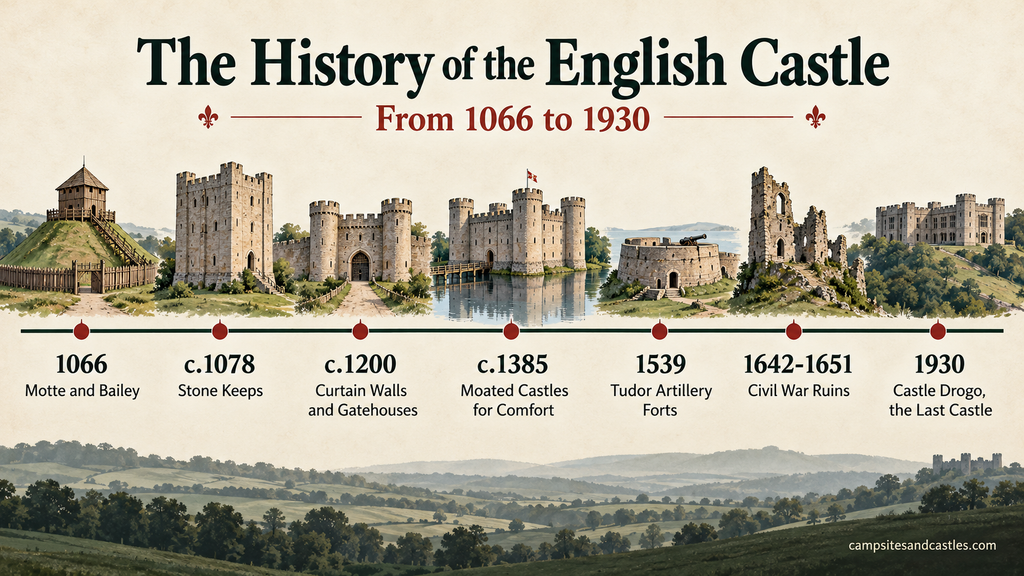
Stand at the foot of almost any English castle and you’re looking at a story of power, fear, ambition and, eventually, comfort. The history of English castles spans nearly 900 years, from hastily dug earth mounds in 1066 to a granite “castle” finished in Devon in 1930.
You don’t need a history degree to enjoy them. Once you know what to look for, every keep, moat and crumbling wall starts to tell you when it was built and why. This beginner’s guide walks you through each era, explains the jargon, and points you to the best castles to see each stage for yourself (with a tent pitched nearby, naturally).
English Castle History at a Glance
If you only have a minute, here’s the whole story in six stages:
- 1066–1100: Earth and timber. The Normans build motte-and-bailey castles at speed to control a conquered country.
- 1070s–1200: Great stone keeps. Timber gives way to massive square towers of stone.
- 1200–1300: Walls and gatehouses. Defence moves outwards to towered curtain walls and, later, concentric rings.
- 1300–1500: Castles as homes. Lords build for comfort and status as much as defence.
- 1500–1651: Gunpowder and war. Cannon make tall walls vulnerable, and the Civil War leaves many castles in ruins.
- 1700 onwards: Romance and revival. Ruins become tourist attractions, and Victorians build mock castles for fun.
Before the Castle: Anglo-Saxon England
Anglo-Saxon England had fortifications, but not really castles. King Alfred the Great and his successors built burhs: fortified towns protected by earth banks and ditches, designed to shelter whole communities from Viking raids.
A castle is different. It’s a private fortress for a lord and his household, built to control the land around it. That idea arrived from Normandy, and a handful of Norman friends of Edward the Confessor built England’s first true castles in the 1050s. The real castle-building boom, though, started with an invasion.
1066: The Normans and the Motte-and-Bailey Castle
When William of Normandy landed at Pevensey in September 1066, one of the first things he did was build a castle inside the old Roman fort there. After his victory at Hastings, castles became his main tool for holding down a hostile population of around two million people with a few thousand soldiers.
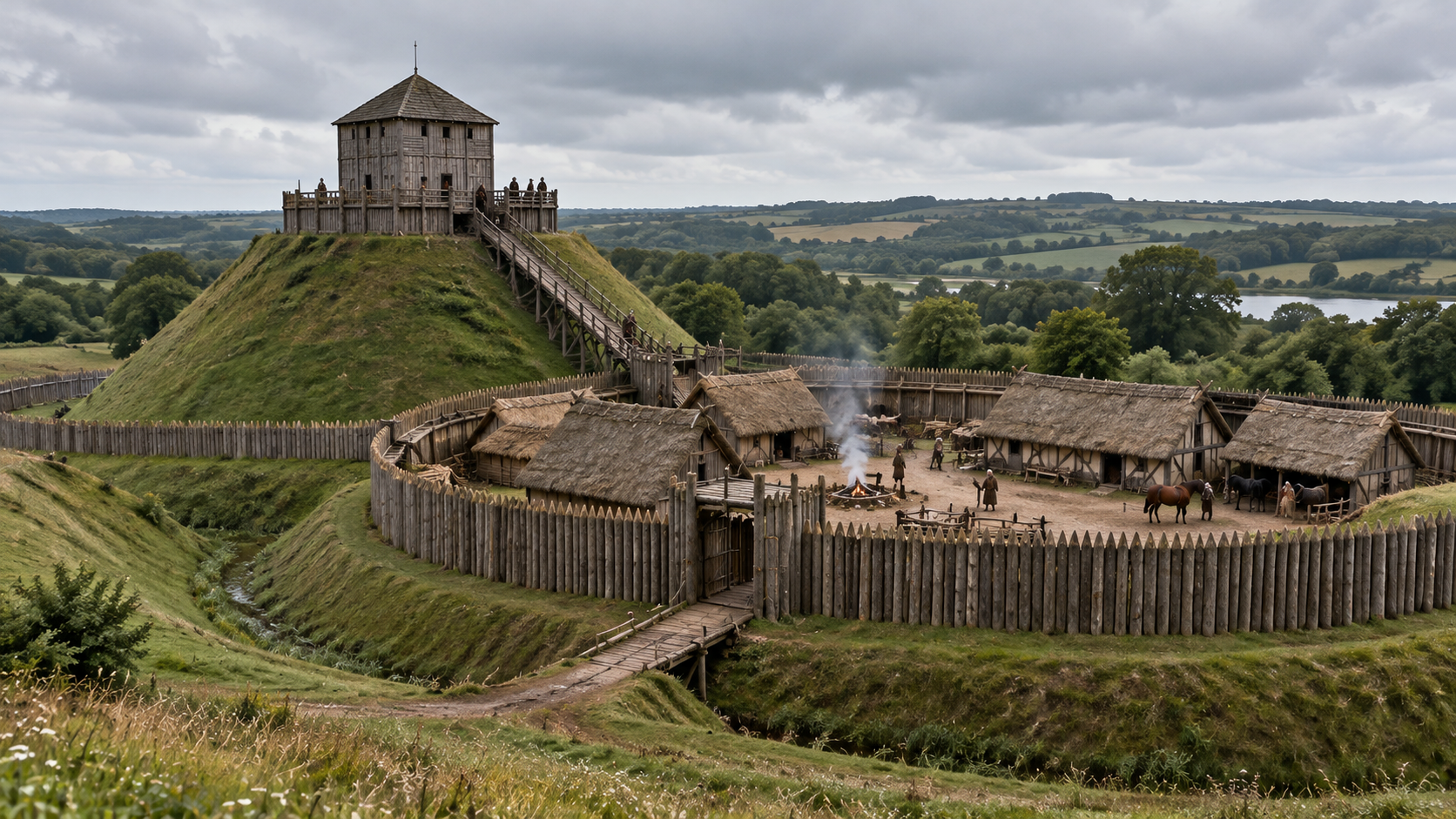
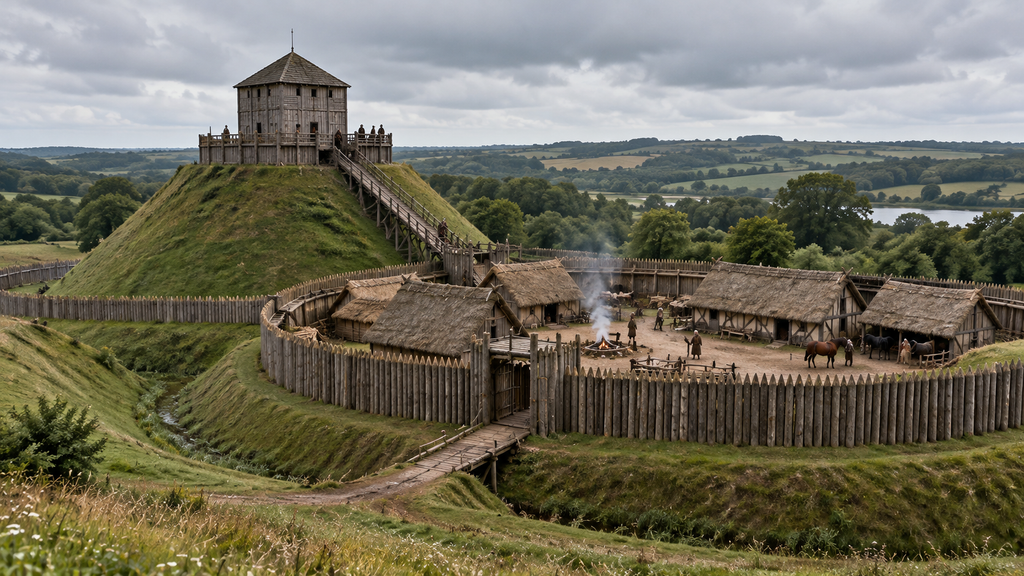
Most early Norman castles followed the motte-and-bailey design:
- The motte was a steep earth mound, sometimes over 10 metres high, topped with a timber tower.
- The bailey was an enclosed yard at its foot, surrounded by a ditch and wooden palisade, holding stables, kitchens, workshops and barracks.
They were quick and cheap. Forced local labour could raise one in weeks, and within a generation hundreds dotted England, placed in towns, at river crossings and along key roads. The timber has long since rotted, but the earthworks survive all over the country. Look for a suspiciously neat, steep grassy hill next to a village church and you’ve probably found one.
Where to see it: Berkhamsted Castle in Hertfordshire has superb motte-and-bailey earthworks, and the mound at Thetford in Norfolk is one of the largest in England.
The Age of the Great Stone Keep (1070s–1200)
Timber burns and rots, so as soon as the Normans felt secure they began rebuilding in stone. The centrepiece was the keep (the Normans called it the donjon, which is where our word “dungeon” comes from): a huge rectangular tower with walls several metres thick.
The most famous is the White Tower at the Tower of London, begun by William the Conqueror around 1078. Its entrance sat at first-floor level, reached by a wooden stair that could be removed in an attack. Colchester Castle in Essex, built around the same time, has the largest Norman keep in Europe.
Keeps were statements as much as defences. A gleaming stone tower told everyone for miles who was in charge.
They weren’t invincible, though. In 1215, King John besieged Rochester Castle in Kent. His miners dug a tunnel under one corner of the keep, propped it with timber, then burned the props using the fat of forty pigs. The corner collapsed. When it was rebuilt, it was made round, and you can still see the mismatched tower today.
Where to see it: the White Tower (Tower of London), Rochester Castle in Kent, Dover Castle’s great tower (built by Henry II in the 1180s), and Orford Castle in Suffolk, with its unusual many-sided keep.
Walls, Towers and Gatehouses (1200–1300)
Lessons like Rochester’s pushed castle builders to rethink. Instead of relying on one strong tower, they made the outer defences the main event:
- Curtain walls studded with towers, so defenders could shoot along the face of the wall at attackers.
- Round towers, which were harder to undermine and deflected missiles better than square corners.
- Mighty gatehouses, with drawbridges, portcullises and “murder holes” overhead, turning the weakest point into the strongest.
Framlingham Castle in Suffolk, built around 1190, shows this new thinking well: there’s no keep at all, just a ring of walls with thirteen towers you can still walk along today.
The idea reached its peak with concentric castles: one ring of walls inside another, with the inner wall higher, so two lines of defenders could fire at once. Edward I built the most famous examples in Wales, such as Beaumaris and Harlech, but you can see concentric defences in England at Dover and the Tower of London.
Water mattered too. Kenilworth Castle in Warwickshire sat behind a vast artificial lake, and in 1266 it held out for around six months, one of the longest sieges in English history.
From Fortress to Family Home (1300–1500)
By the 14th century, England was more settled at home, and a castle’s job began to change. Lords still wanted something that looked defensible, but they increasingly wanted comfort, light and space to entertain.
To build a castle, a lord needed royal permission called a licence to crenellate: in effect, a licence to add battlements. For many, those battlements were as much a status symbol as a defence.
This era produced some of England’s most picture-perfect castles:
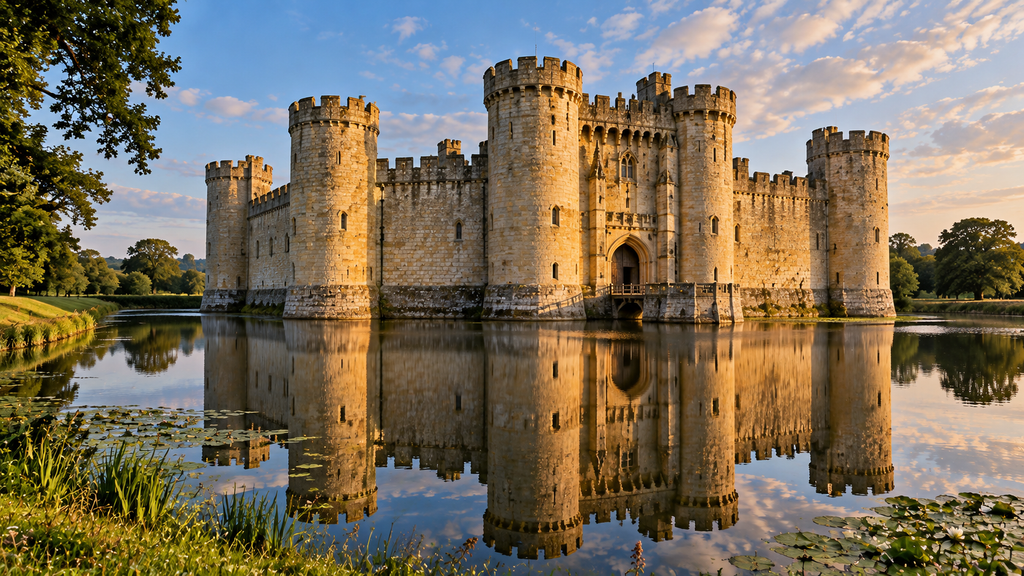
- Bodiam Castle in East Sussex (licensed 1385) is a near-symmetrical square of towers rising from a wide moat. Historians still debate how much it was built for war and how much for show.
- Bolton Castle in Wensleydale was built as a comfortable lordly residence around a courtyard, and later held Mary, Queen of Scots, as a prisoner.
- Tattershall Castle in Lincolnshire and Herstmonceux in Sussex were built of brick in the 15th century, a fashionable and expensive material at the time.
Where to see it: Bodiam, Bolton and Tattershall are all open to visitors, and Bodiam’s moat is one of the best photo spots in southern England.
Gunpowder Changes Everything (1450–1550)
Cannon spelled the end of the tall, thin-walled castle. During the Wars of the Roses, Bamburgh Castle in Northumberland became the first castle in England to fall to artillery fire, in 1464.
When Henry VIII feared a French and Spanish invasion in 1539, he didn’t build traditional castles. He built Device Forts: low, squat artillery forts with thick, rounded walls designed to deflect cannonballs and mount guns of their own. Deal and Walmer in Kent and Pendennis and St Mawes in Cornwall are superb survivors, and they look completely different from anything medieval.
The Civil War and the Slighting of the Castles (1642–1651)
Many old castles had one last fight left in them. During the English Civil War, Royalist garrisons dug in behind medieval walls, and some held out for months against Parliament’s armies.
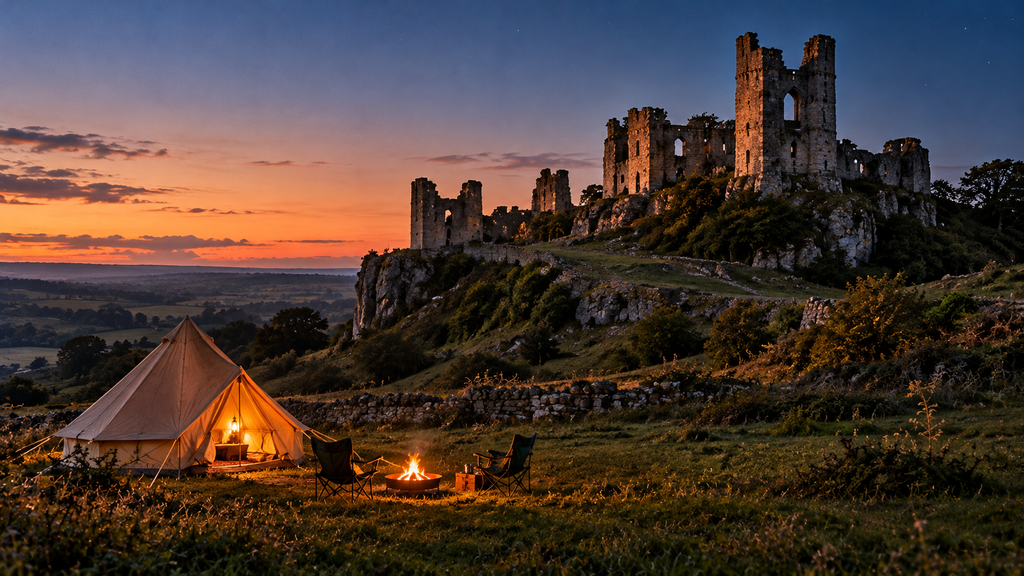
After the war, Parliament made sure they could never be used again. Castles were slighted: deliberately damaged by blowing up towers and breaching walls. Corfe Castle in Dorset, Kenilworth and Pontefract were all wrecked this way. If you’ve ever wondered why so many English castles are dramatic ruins, the Civil War is a big part of the answer.
Where to see it: Corfe Castle’s shattered towers, still leaning where the gunpowder left them, are an unforgettable sight.
Romantic Ruins and Victorian Revival (1700–1930)
By the 18th century, ruined castles had become fashionable. Artists painted them, poets wrote about them, and wealthy landowners even built fake ruins (called “follies”) in their gardens.
The Victorians took it further with the Gothic Revival, adding turrets and battlements to country houses and restoring medieval castles, sometimes with more enthusiasm than accuracy.
The last chapter belongs to Castle Drogo in Devon. Designed by Sir Edwin Lutyens and built between 1911 and 1930, it’s often called the last castle built in England, a granite fortress with all the drama of the Middle Ages and the comforts of the 20th century.
Meanwhile, one castle never stopped being lived in. Windsor Castle, founded by William the Conqueror around 1070, is the oldest and largest occupied castle in the world.
Castle Words Every Beginner Should Know
- Bailey: the enclosed courtyard of a castle.
- Barbican: an outer defence protecting the gateway.
- Battlements (crenellations): the gap-toothed parapet along the top of a wall.
- Curtain wall: the main outer wall linking a castle’s towers.
- Keep (donjon): the great central tower, the castle’s last line of defence.
- Motte: the earth mound of an early Norman castle.
- Portcullis: a heavy grille that drops down to block the gateway.
- Slighting: deliberately damaging a castle so it can’t be used again.
How to See English Castle History for Yourself
The best way to understand English castles is to visit them in order. A single road trip can take you from Norman earthworks to Tudor gun forts in a weekend. Kent alone has Rochester, Dover, Deal and Walmer within an hour of each other.
Most of the castles in this guide are cared for by English Heritage or the National Trust. Membership of either pays for itself quickly if you’re planning a summer of castle-hopping, and many castle ruins in England are free to visit.
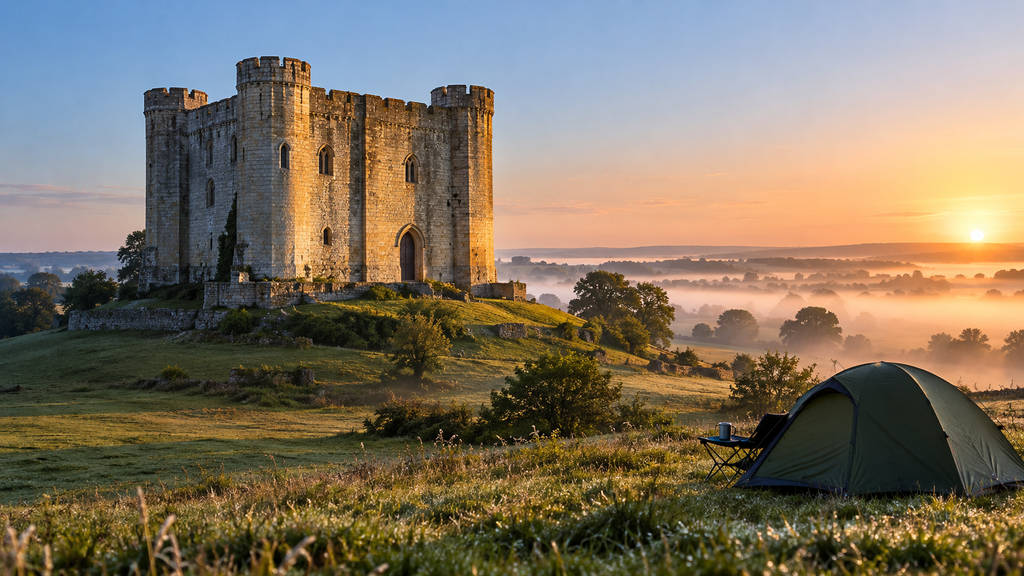
And because this is Campsites and Castles, here’s our favourite tip: stay close. Pitching a tent within sight of a castle means you can arrive before the coach parties, and watch the walls glow at sunset when everyone else has gone home.
Frequently Asked Questions
When were the first castles built in England?
A few were built by Norman lords in the 1050s, under Edward the Confessor, but castle-building took off after the Norman Conquest of 1066.
What is the oldest castle in England?
There’s no single agreed answer, as many castles began as timber and were rebuilt. Pevensey and Hastings date from 1066, and the White Tower and Colchester keep from the 1070s are among the oldest surviving stone castle buildings.
Why are so many English castles in ruins?
Many were abandoned as castles stopped being useful homes or defences, and many more were deliberately slighted by Parliament after the Civil War of 1642–1651.
What was the last castle built in England?
Castle Drogo in Devon, completed in 1930, is usually given that title.
Start Your Own Castle Adventure
The history of the English castle is really the history of England itself: conquest, rebellion, civil war and, finally, a love of the past. Start with one era, visit a castle that shows it off, and you’ll soon be spotting mottes and murder holes everywhere you go.
Ready to plan your trip? Read our Ultimate Guide to Camping Near UK Castles and find the perfect pitch for your first castle weekend.