
The Most Spectacular Castles in Wales (And Where to Camp Nearby)
Wales has more castles per square mile than any other country in Europe — over 600 of them, scattered across mountains, coastlines, and river valleys. Some are polished World Heritage Sites; others are wild, crumbling ruins you might have entirely to yourself on a misty morning.
If you’re planning a Welsh castle adventure, this guide covers the ten most spectacular castles in Wales, what makes each one special, and — because this is Campsites and Castles — where you can pitch a tent nearby. For the full picture of castles across Britain, start with our Complete Guide to UK Castles.
The Complete Guide to UK Castles
1. Conwy Castle, North Wales
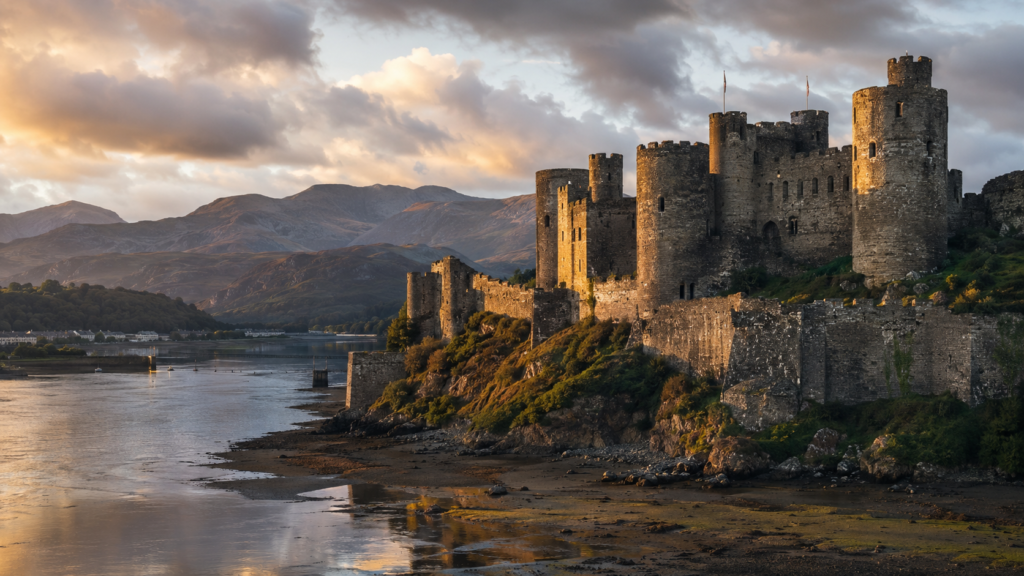
If you only visit one castle in Wales, make it Conwy. Built by Edward I between 1283 and 1287, this UNESCO World Heritage Site rises straight out of the rock above the Conwy estuary, with eight enormous drum towers and some of the best-preserved medieval town walls in Europe.
Climb the towers for views across Snowdonia (Eryri) and the estuary, then walk the full circuit of the town walls — three-quarters of a mile of continuous medieval fortification.
Don’t miss: The view from the battlements at sunset, when the estuary turns gold.
Camping nearby: Conwy Touring Park sits just a couple of miles south of the castle in a wooded valley, and the Conwy Valley has several small farm sites within a 15-minute drive.
2. Caernarfon Castle, Gwynedd
Caernarfon isn’t just a castle — it’s a statement. Edward I designed it as the seat of English power in Wales, with distinctive banded masonry and polygonal towers inspired, it’s said, by the walls of Constantinople. It’s also where Prince Charles was invested as Prince of Wales in 1969.
The Eagle Tower is one of the largest ever built in medieval Britain, and the wall walks give you sweeping views over the Menai Strait to Anglesey.
Don’t miss: The Royal Welch Fusiliers Museum inside the castle, included in your ticket.
Camping nearby: You’re spoiled here — campsites dot the coast between Caernarfon and Dinas Dinlle beach, and Snowdonia’s sites are a short drive inland.
The Best Campsites Near Caernarfon Castle, North Wales
3. Harlech Castle, Snowdonia
Perched on a near-vertical crag with Snowdonia’s peaks behind it and Cardigan Bay in front, Harlech might be the most dramatically sited castle in Britain. It withstood the longest siege in British history (seven years, during the Wars of the Roses) and inspired the song Men of Harlech.
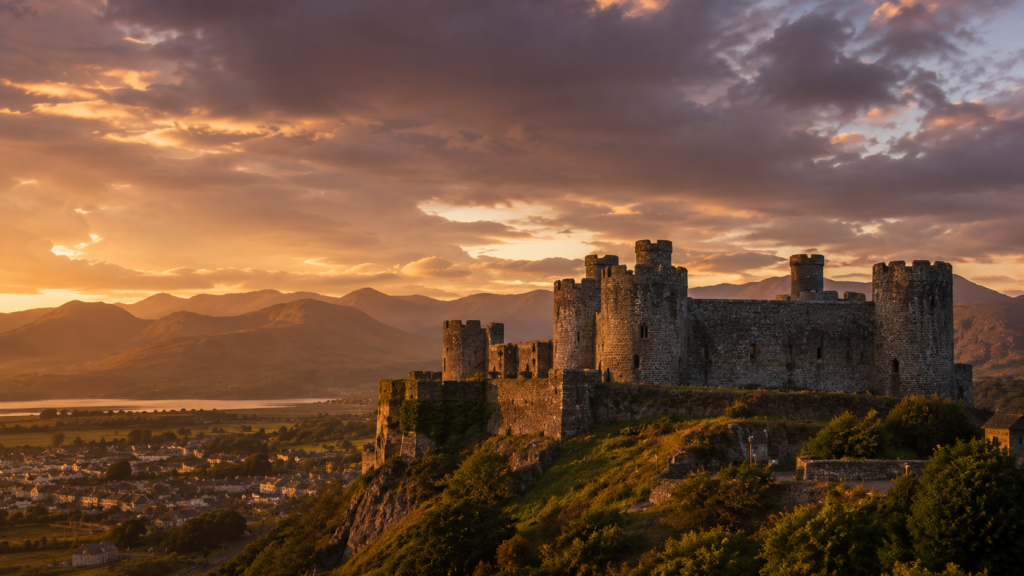
A striking modern footbridge now floats you across to the gatehouse, roughly following the route medieval visitors would have taken.
Don’t miss: The view from the ramparts on a clear day — sea, sand dunes, and the full Snowdon massif in one panorama.
Camping nearby: Shell Island, one of Europe’s largest campsites, is just down the coast at Llanbedr, with beach camping among the dunes.
4. Beaumaris Castle, Anglesey
Beaumaris is the great unfinished masterpiece. It was the last and most technically perfect of Edward I’s “Iron Ring” of castles — a flawless concentric design with a moat, ringed defences, and a dock where ships could sail right up to the walls. Money and attention ran out before it was completed, which somehow adds to its charm.
It’s quieter than Conwy or Caernarfon, and its symmetry is genuinely beautiful, especially reflected in the moat on a still day.
Don’t miss: Walking the inner wall passages — kids love the tunnels and staircases.
Camping nearby: Anglesey is superb camping territory, with coastal sites at Benllech and Red Wharf Bay within 20 minutes.
5. Caerphilly Castle, South Wales
Caerphilly is the largest castle in Wales and the second largest in Britain after Windsor. Built in the 13th century by the Norman lord Gilbert de Clare, it’s surrounded by vast artificial lakes that formed part of its defences — a genuine water fortress.
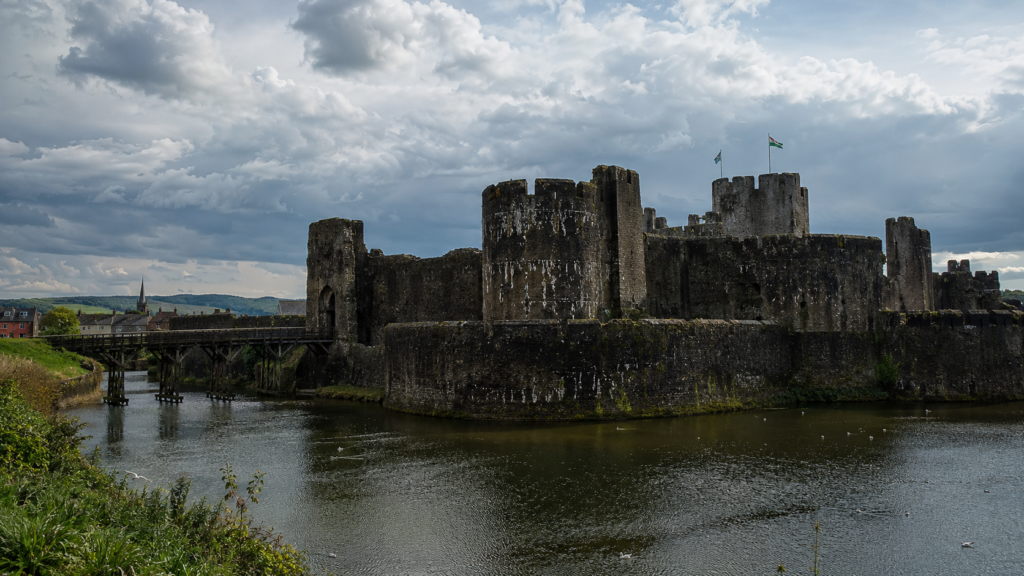
Its famous leaning tower out-leans Pisa, a legacy of Civil War-era slighting, and the great hall has been beautifully restored.
Don’t miss: The replica siege engines on the dam platforms — they’re occasionally fired at events.
Camping nearby: Sites in the Rhymney and Taff valleys put you within easy reach, and Cardiff is only 20 minutes away for a city day.
6. Pembroke Castle, Pembrokeshire
Wrapped almost entirely by a tidal river, Pembroke Castle is the birthplace of Henry VII and the seat of the mighty Marshal earls. Its round keep — nearly 80 feet tall with walls 19 feet thick at the base — is one of the finest in Europe.
Beneath the castle lies Wogan Cavern, a huge natural cave used since the Stone Age, reached by a spiral staircase from the castle above.
Don’t miss: The keep’s domed roof and the cavern below — few castles anywhere offer both.
Camping nearby: Pembrokeshire is arguably the best camping county in Wales; coastal sites near Freshwater East and Bosherston are within 15 minutes.
7. Carreg Cennen Castle, Carmarthenshire
Ask Welsh castle lovers for their favourite and Carreg Cennen comes up again and again. This brooding ruin sits on a 300-foot limestone cliff on the western edge of the Brecon Beacons (Bannau Brycheiniog), reached by a steep walk up from a working farm.
Bring a torch: a narrow vaulted passage leads along the cliff face into a natural cave beneath the castle. It’s atmospheric in a way the polished sites can’t match.
Don’t miss: The cave passage, and the tearoom at the farm below — the rare breeds farm is great with kids.
Camping nearby: Small rural sites around Llandeilo and the western Beacons make this perfect wild-feeling camping country.
8. Castell Coch, Cardiff
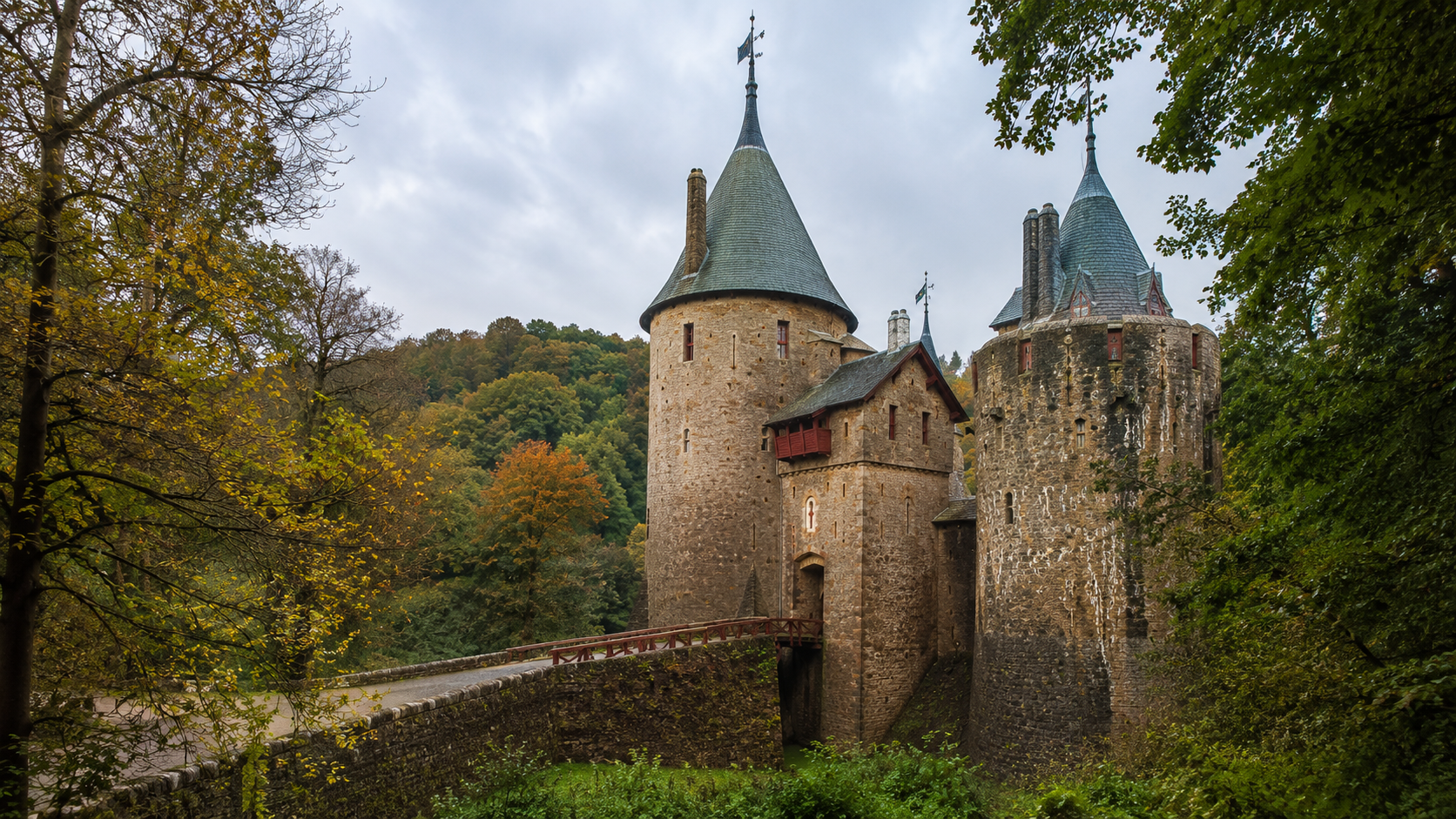
A complete change of pace: Castell Coch (the “Red Castle”) is a Victorian Gothic fantasy built on medieval foundations by the eccentric architect William Burges for the 3rd Marquess of Bute. Rising from beech woods just north of Cardiff, its conical turrets look lifted straight from a fairytale.
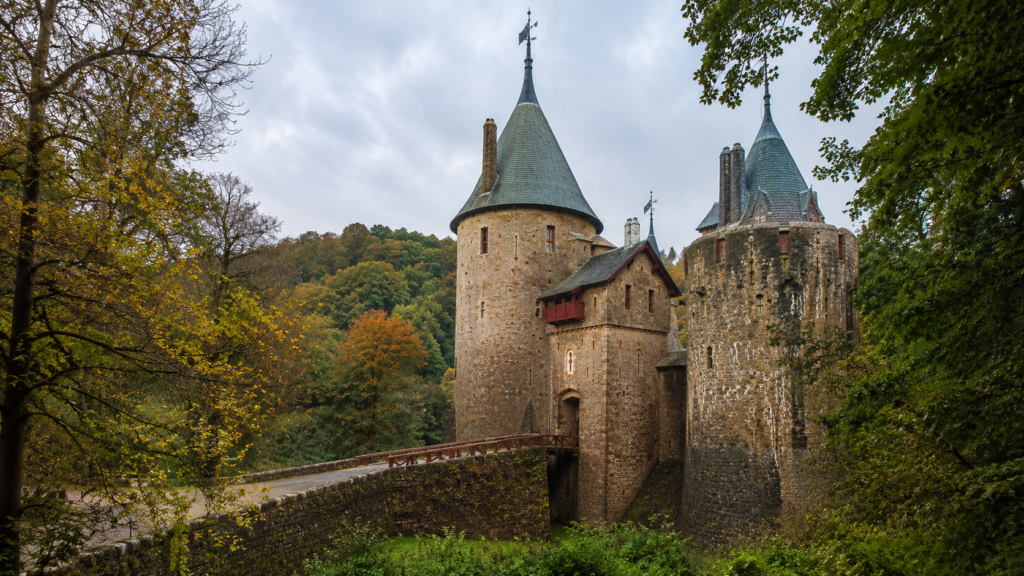
Inside, the decoration is jaw-dropping — painted ceilings, gilded interiors, and rooms crowded with birds, butterflies, and scenes from Aesop’s fables.
Don’t miss: Lady Bute’s bedroom, with its domed and mirrored ceiling.
Camping nearby: Sites on the edge of the Taff Valley and towards Caerphilly work well; you can easily pair Castell Coch and Caerphilly Castle in one day.
9. Criccieth Castle, Llŷn Peninsula
Criccieth is proof that spectacular doesn’t have to mean huge. This compact ruin crowns a headland between two beaches on the Llŷn Peninsula, and it’s one of the few great Welsh castles actually built by the Welsh — begun by Llywelyn the Great in the 1230s before Edward I captured and extended it.
The setting is everything: sea on three sides, Snowdonia on the horizon, and an ice cream shop in the town below with a serious reputation.
Don’t miss: Sunset from the beach below, with the castle silhouetted above.
Camping nearby: The Llŷn Peninsula and nearby Porthmadog area are packed with family-friendly coastal campsites.
10. Raglan Castle, Monmouthshire
Raglan is the last great medieval castle built in Britain — a 15th-century palace-fortress of golden sandstone, built more to impress than to intimidate. Its Great Tower, the “Yellow Tower of Gwent,” stands on its own island within a moat, and the grand Tudor apartments hint at serious luxury.
It endured one of the longest sieges of the Civil War before surrendering in 1646, and the ruins remain remarkably grand.
Don’t miss: Climbing the Great Tower for views across the Monmouthshire countryside.
Camping nearby: The Wye Valley and Usk Valley nearby offer lovely riverside sites — ideal for combining Raglan with Chepstow and Tintern Abbey.
Planning Your Welsh Castle Trip
A few practical tips before you set off:
Get a Cadw membership or Explorer Pass. Most of the castles on this list are cared for by Cadw, the Welsh heritage body. If you’re visiting three or more sites, a Cadw Explorer Pass (3 or 7 days) usually pays for itself.
Go north or south — not both in one trip. North Wales (Conwy, Caernarfon, Harlech, Beaumaris, Criccieth) makes one brilliant road trip; South and West Wales (Caerphilly, Pembroke, Carreg Cennen, Castell Coch, Raglan) makes another. Trying to do both in a weekend means spending your holiday on the A470.
Book campsites early for summer. Welsh coastal sites fill up fast for school holidays. Shoulder seasons (May, June, September) offer quieter castles, cheaper pitches, and — with luck — better light for photography.
Check opening times. Some smaller sites close over winter or have reduced hours; Cadw’s website has current details.
Wales rewards slow travel. Pitch up somewhere with a sea view, spend your days climbing battlements, and you’ll understand why this small country built — and kept — more castles than anywhere else on Earth.


